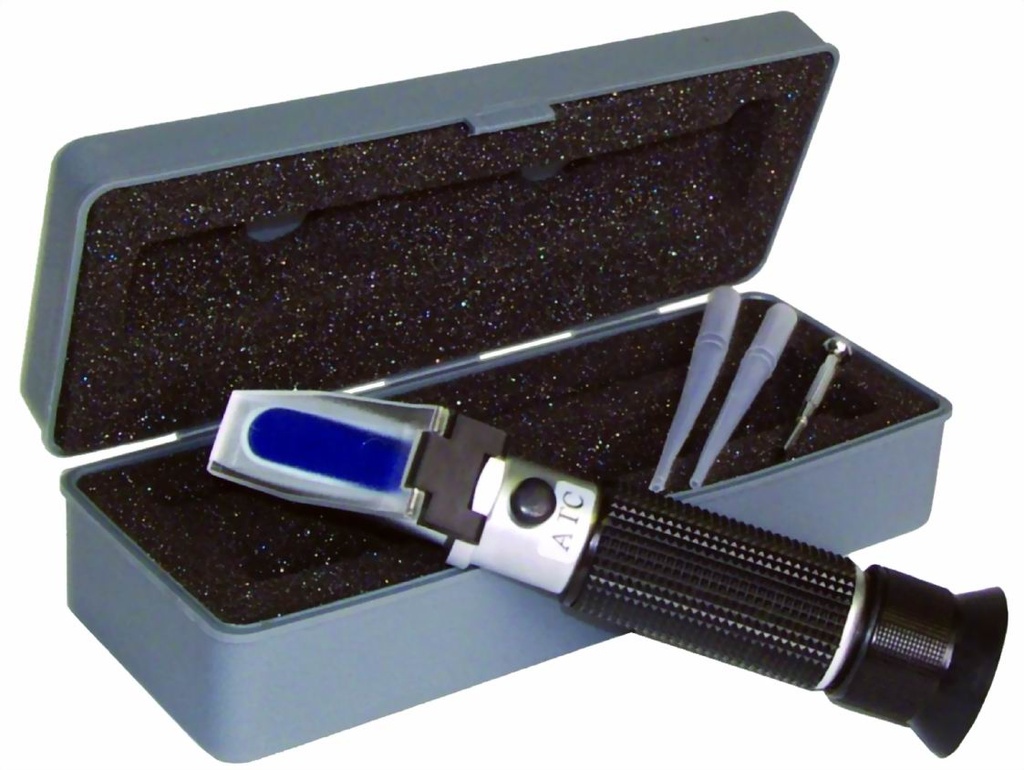
Refractometer
Professional laboratory refractometer with built-in automatic temperature compensation ranging from 10 degrees C to 30 degrees C (50 to 86 degrees F). Available in two models for different measurement applications.
Available Models
| Model |
Application |
Range |
Resolution |
| CTL-REFM-PRSG |
Total Protein in serum |
0 to 12 g/dl |
0.2 g/dl |
| CTL-REFM-PRSG |
Specific Gravity in urine |
1.00 to 1.05 sg |
0.002 sg |
| CTL-REFM-BR32 |
Brix sugar content |
0 to 32 % |
0.2 % |
Physical Specifications
| Parameter |
Value |
| Size |
30 x 160 mm |
| Weight |
215 g |
Key Components
- Adjusting Focusing Eyepiece
- Prism
- Cover Plate
- Calibration Screw
- Tube
- Focusing Eyepiece
Calibration
Prior to inserting a sample, aim the front of the refractometer toward a bright indoor light source. Adjust the focusing eyepiece ring until the graduations on the scale can be clearly seen through the eyepiece.
Lift the cover plate and add 1 or 2 drops of distilled water on the surface of the prism. Lower the cover plate, making sure that the water covers the entire surface of the prism. View the scale through the eyepiece and, using the enclosed small screwdriver, turn the adjustment screw to make the light/dark boundary coincide (meet) at the "W" at the bottom of the protein scale (Protein / SG model) or at the 0 % mark (BRIX model). Using a soft cotton cloth or absorbent paper, clean and dry the prism before measuring the first specimen.
Operation
Protein / Specific Gravity Model CTL-REFM-PRSG: Lift the cover plate and add 1 or 2 drops of urine or serum (or plasma) depending on which test is desired. Lower the cover plate. Lightly press the cover plate, making sure the liquid is evenly distributed across the prism. You can now read the value of the protein concentration (for serum or plasma) or specific gravity (for urine) from the appropriate scale by reading the boundary line between the light and dark area as it intersects the scale.
BRIX Model CTL-REFM-BR32: Lift the cover plate and add 1 or 2 drops of liquid, such as wine, fruit juice, or other liquids containing sugar. Lower the cover plate. Lightly press the cover plate, making sure the liquid is evenly distributed across the prism. You can now read the percentage of sugar content from the percentage scale by reading the boundary line between the light and dark area as it intersects the scale.
Applications
Testing Quality of Colostrum for Feeding Young Calves (BRIX Model CTL-REFM-BR32): Follow the operating instructions above for the BRIX refractometer, using 1 or 2 drops of colostrum. Research indicates that BRIX scores of 22% or higher represent good quality in colostrum, 18-21% represent colostrum that can be used for second feedings, and scores below 17% will need to be supplemented.
Testing Total Solids in Milk for Feeding Older Calves (BRIX Model CTL-REFM-BR32): Follow the operating instructions above for the BRIX refractometer, using 1 or 2 drops of milk. The expected content of total solids in normal milk would be 12.5% to 13%. The following equation was developed by Penn State to convert BRIX reading to total solids in milk:
TOTAL SOLIDS = (0.9984 x BRIX reading) + 2.077
Therefore, a BRIX reading of 10.4% equals 12.5% total solids, and a reading of 10.9% equals 13% total solids.
Maintenance and Cautions
- Always treat specimen samples as though they were infectious
- Keep the refractometer horizontal as you look into the eyepiece, so that the specimen sample will be less likely to drip out and contaminate the user and/or the surroundings
- Clean the refractometer between samples and when done using the instrument
- After use, clean with distilled water only. Rinse and dry the glass and metal parts
- Store the refractometer in its case in a clean, cool, dry, non-corrosive atmosphere
- Handle the hinged cover plate carefully, so as not to break the hinge
- When calibrating, the distilled water and specimens to be measured should all be the same temperature. If the temperature varies greatly between the two, the calibration should be adjusted once every 30 minutes
- Never immerse the refractometer in water
- Use extra caution when cleaning to avoid scratching the prism
- Care should always be used when handling, cleaning, and storing. Storage in a clean, dry, non-corrosive atmosphere is recommended
- Avoid dropping or strong shocks