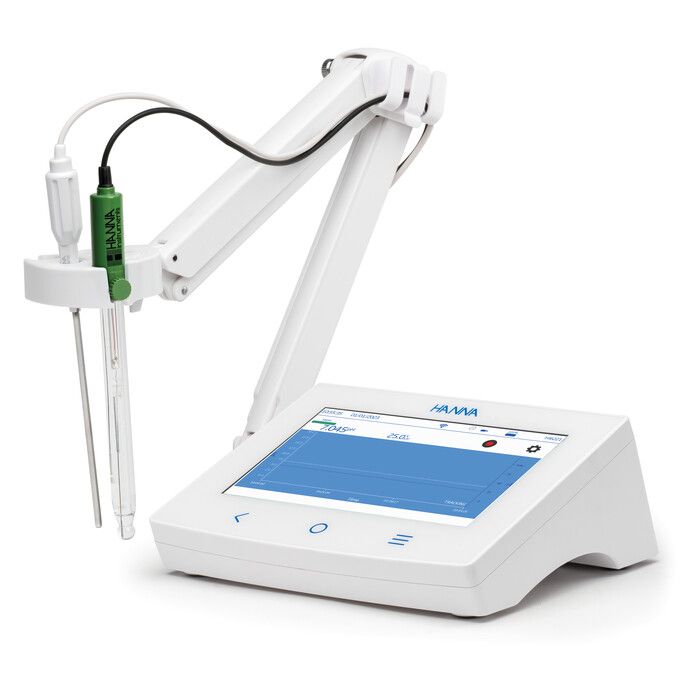
HI6000 Series Multiparameter Modular System
The HI6000 multiparameter modular system is a totally flexible benchtop meter platform that is customizable to a user's laboratory measurement and application needs. This system accommodates up to three measurement modules in any combination, providing quick and reliable measurement displayed on a large touch screen display.
Available Measurement Modules
Four different measurement modules are available for pH/ORP, pH/ORP/ISE, EC, and DO. Each module operates with appropriate sensors and can be easily installed or swapped to match specific application requirements.
HI6000-1 pH/ORP Module
- Parameters: pH, mV
- Recommended Probe: HI1131B Refillable combination pH electrode
- Temperature Probe: HI7662-TW Stainless steel Temperature probe
- Note: For ORP (redox) measurements a separate sensor is required
HI6000-2 pH/ORP/ISE Module
- Parameters: pH, mV, Rel. mV, ISE
- Modes: Direct, Direct/Autohold, Known Addition, Known Subtraction, Analyte Addition, Analyte Subtraction
- Features Incremental Methods for Ion Selective Electrode (ISE) applications
- Recommended Probes: HI1131B pH electrode, HI7662-TW Temperature probe, Hanna Ion Selective Electrodes
- Reports of each analysis are recorded for download
HI6000-3 Conductivity Module
- Parameters: Conductivity (μS/cm or mS/cm), Resistivity (Ω•cm, kΩ•cm, MΩ•cm), TDS (ppm or ppt), Salinity (ppt, PSU, %)
- Modes: Direct, Direct/Autohold, Direct/USP
- Supports measurement of high purity water used in the pharmaceutical industry
- Includes meter verification and cell validation applications
- Programmed for the three stages of the USP <645> bulk water analysis
- Recommended Probe: HI7631233 EC and resistivity probe
HI6000-4 Dissolved Oxygen Module
- Modes: Direct (% Sat, mg/L, ppm), Autohold, BOD (ppm, mg/L), OUR (mg/L, ppm), SOUR (mg/L, ppm)
- Supports dissolved oxygen applications for batch analysis of multiple samples
- Includes Oxygen Uptake Rate (OUR), Specific Oxygen Uptake Rate (SOUR), Biological Oxygen Demand (BOD)
- Reports available for analysis records
- Recommended Probes: HI7641133 Optical DO probe, HI764833 Polarographic DO probe
Primary Features
- Multiparameter measurement flexibility with plug-and-play design
- Effortless installation and module swapping capability
- Application-specific profiles allow quick and direct measurement without the need to update sensor and system settings
- Active log during measurement
- Measurement stability indicator using the Stability Criteria setting
- Temperature compensation: automatic (using temperature probe or integral temperature sensor within probe) or manual
- Audible and/or alarm messages for measurements outside predefined limits
- Galvanic isolation for measurement modules
- Non-volatile memory saves data and settings
Display and Interface
The benchtop unit features a 7-inch color capacitive touch screen with multi-touch support and 800 x 480p resolution. The display supports video playback and data plotting. Up to three measurements can be shown on screen simultaneously in single-parameter, dual-parameter, or triple-parameter configurations. Views can be mixed and matched.
Display Elements
- Status area with current time, date, network connectivity, devices connectivity, storage space availability, and current logged in user
- Stability indicator
- Active measurement profile
- Logging status icons
- Module measurement settings access
- Measurement readings with additional measurements
- Probe and calibration information
- Active modules status
- Navigation keys (Back, Home, System Menu)
Data Logging Capabilities
- User controlled data log collection of at least 1,000,000 data points with time and date stamp
- Logging types: manual, automatic, autohold
- Sample ID for manual and autohold data
- 50,000 maximum records per file
- Log files include measurements and calibration data as .CSV file
- Data can be viewed tabulated (complete with date, time, and notes) or plotted as graph
Connectivity and Data Transfer
- Transfer logged data to a USB thumb drive
- FTP and email for log export via ethernet and Wi-Fi connection
- Download logs using the benchtop's embedded web server
- USB type A (2 ports) for USB drive, printer, and keyboard
- USB type C (1 port) for USB drive and PC connection
- Ethernet port
- RS232 for connecting peripherals
System Menu Functions
Through the System Menu, control user accessibility, system and connectivity configuration, access logged data, reports, and video-supported help.
- Users: Login and rights configuration, instrument accessibility, up to 9 users plus default administrator account
- System Settings: System configuration, connectivity, printing items, time, date, language, meter ID, decimal separator, backlight saver, audible signals, startup tutorial
- Log Recall: Access logged measurement data, selection, deletion, and sharing via USB, FTP, web server, and email
- Reports: Application reports with GLP data
- Help: Video-supported outline of main instrument functionalities
View Configuration Options
pH Views
- Basic: Displays measured value, measurement unit, and temperature source
- Simple GLP: Adds last calibration date and time, Offset value, average slope (Avg. Slope), and electrode condition
- Full GLP: Adds electrode symbol, used buffer trays with calibration date, time, and temperature probe status
- Graph: Measured value plotted as graph with zoom and pan options
- Table: Measured values displayed tabulated with date, time, and notes
mV Views
Basic, Graph, Table
Rel. mV Views
Simple GLP, Basic, Graph, Table
Measurement Setup Configuration
- Reading: Parameter, Resolution, Stability Criteria, Reading Mode customization
- Temperature: Automatic or manual temperature Source, °C, °F, or K temperature Unit, Manual Temperature input, Isopotential Point
- Alarm configuration: High and low threshold limits for measured parameters with audible and visual alerts
- Logging: Type (Automatic, Manual, or Autohold), Sampling Period (Automatic), File Name (Manual and Autohold), Sample ID (Manual and Autohold)
- Profiles: Sensor setup with measurement unit, temperature unit, display preference, and alarm threshold options
Calibration Features
pH Calibration
- Up to 5-point calibration
- Type: Automatic, Semiautomatic, Manual
- Standard buffers: Hanna and NIST pH 1.68, 3.00, 4.01, 6.86, 7.01, 9.18, 10.01, 12.45
- Up to 5 custom buffers
- Up to 5 custom buffer groups
- First calibration point: Offset or Points (user setting)
- Automatic buffer recognition for standard buffers
ISE Calibration (HI6000-2)
- 5-point calibration
- Automatic, up to five-point calibration
- Seven fixed standard solutions available for each measurement unit
- Five user defined standards
- Choice of concentration units: ppt, g/L, mg/mL, ppm, mg/L, μg/L, ppb, μg/mL, mg/mL, M, mol/L, mmol/L, %w/v, and user-defined unit
Conductivity Calibration
- Single or multiple point calibration with standards
- Calibration solutions: 84.00 μS/cm; 1.413 mS/cm; 5.000 mS/cm; 12.88 mS/cm; 80.00 mS/cm; 111.8 mS/cm
- Standard single point salinity calibration in 100% salinity standard
Dissolved Oxygen Calibration
- One or two points calibration at 0% and/or 100% saturation
- Single point manual calibration in mg/L or % saturation using a reference method
Calibration Reminder
- Daily: 0 min. to 23 hours and 59 min.
- Periodic: 1 min. to 30 days, 23 hours and 59 min.
- Disabled
ISE Incremental Methods
The HI6000-2 module features incremental methods for Ion Selective Electrode applications. Known Addition, Known Subtraction, Analyte Addition, and Analyte Subtraction are versatile methods for the measurement of ions in aqueous samples from environmental, agricultural, industrial, biotechnical, pharmaceutical, food, wastewater, and drinking water. These methods offer stepwise guidance for ion analysis and are ideal for complex or high ionic strength samples as the electrodes remain immersed throughout the process, making analysis faster and more accurate.
EC USP Mode
The HI6000-3 EC module can be used for conductivity measurements required to prepare water for injection (WFI) according to USP <645>. The system provides clear instructions on how to perform each stage and automatically checks that the temperature, conductivity, and stability are within USP limits.
The Direct/USP mode is a special mode with specific measurement settings defined by the United States Pharmacopoeia Regulations and European Pharmacopoeia. The process involves three parts: Meter Validation with precision resistors, Cell Verification with conductivity standard, and Stage 1, 2, and 3 water tests. The results of each test are recorded in a report that includes information such as company name, date and time, instrument ID, operator ID, sample ID, module types used, calibration details, and test results.
Recommended Probes
pH/ORP/ISE Probes
The HI1131B is a glass body, double junction, refillable pH electrode with an indicating sensor made of High Temperature (HT) glass. The double junction reference and HT glass design allow the electrode to be used in a wide variety of applications including samples with metals and elevated temperatures. Probe connection to the unit is secured through a galvanically isolated BNC connection. The HI7662-TW stainless steel temperature probe allows the meter to automatically temperature compensate (ATC) pH measurements.
Conductivity Probe
The HI7631233 four-ring conductivity/resistivity/TDS/salinity probe is recommended for a wide range of industrial process water applications. The probe provides stable measurements over a wide measurement range and does not require frequent calibrations. An integral temperature sensor measures the process temperature and adjusts the measured conductivity to a reference temperature by applying specialized compensation algorithms: Linear, Standard (appropriate for high-purity water measurements and documented in ASTM Standard D5391-14, should be used for >1Mohm.cm resistivity measurements), and Natural (appropriate for natural ground, well, or surface water in accordance with ISO7888 standard).
Dissolved Oxygen Probes
HI7641133 Optical Dissolved Oxygen Probe (opdo®): Based on the principle of fluorescence quenching. An immobilized Pt-based luminophore is excited by the light of a blue LED and emits a red light. As oxygen interacts with the luminophore it reduces the intensity and lifetime of the luminescence. The lifetime of the luminescence is measured by a photodetector and is used to calculate the dissolved oxygen concentration.
The probe is fitted with easy to use Smart Caps (HI764113-1) which lock in place and contain pre-loaded calibration coefficients that are automatically transmitted to the probe. The Smart Cap features an immobilized O₂ sensitive luminophore with rugged insoluble black oxygen permeable protective layer. Over time, the sensor's optical components can age but are compensated for by using the reference signal to compensate the measuring path. As a result, the sensor provides accurate DO measurements over long periods of time without the need for frequent calibration.
HI764833 Polarographic Probe: The slim and versatile polarographic probe covers a wide range of dissolved oxygen and has a built-in thermistor temperature sensor that compensates for temperature variations. The slim design allows for convenient measurement in test tubes and Biological Oxygen Demand (BOD) bottles. Durable and robust, the probe features a platinum cathode and Ag/AgCl anode assembly. Accurate and with a fast response time. The probe is fitted with durable (PTFE), oxygen permeable, screw on membrane caps. Caps are filled with electrolyte and easily install on the probe.
Concentration measurements are automatically compensated for barometric pressure, temperature, and salinity. Barometric pressure and temperature are automatically measured and compensated. Salinity is automatically compensated by setting manually the salinity concentration of the water being measured. Pressure compensation is done automatically (built-in barometer) or users have the option to manually enter required value. Pressure is displayed in user-configurable units: mmHg, mbar, kPa, inHg, psi, atm.
Salinity Measurement
TDS: A calculated value based on the conductivity of the solution (TDS = factor x EC25). A TDS factor is a conversion factor used to change an EC measurement to a ppm measurement.
Salinity PSU: The