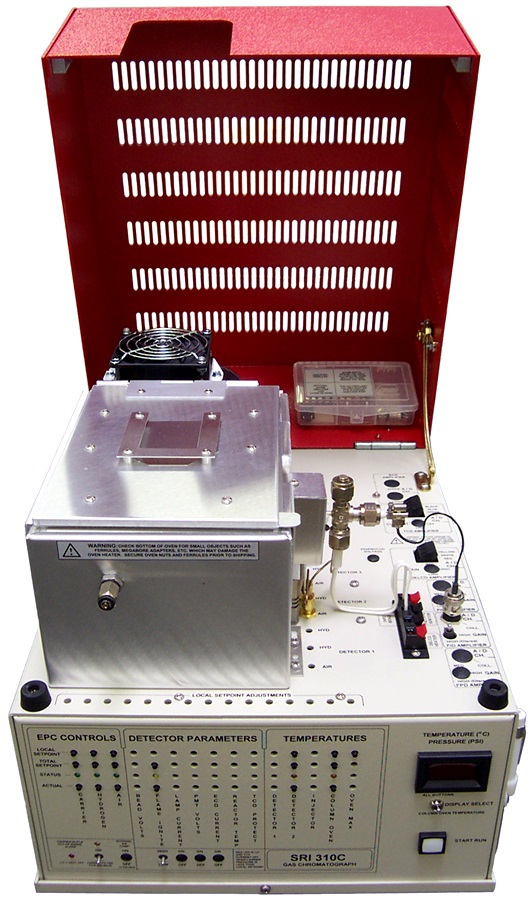
SRI Family of Educational GC Systems
SRI Educational GC systems are ideal for undergraduate chemistry classes where the principles of gas chromatography are demonstrated on the same equipment students will encounter in industry. These GCs are configured on the compact 310 chassis, so they take up a minimum of bench space. Choose from two detector types: Thermal Conductivity Detector (TCD) or Flame Ionization Detector (FID), and standard or gasless configurations. Each SRI Educational GC includes a single channel, Windows-based PeakSimple data system, a one meter Silica Gel or HaySep D packed column, and Electronic Pressure Control (EPC). Gasless Educational GCs also include built-in, whisper-quiet air compressors, and for the FID GC, a hydrogen generator, which allows for operation without external gas supplies.
Standard Features
- 310 chassis: 12.5" W x 14.5" D x 12.5" H
- Single Channel PeakSimple Data System
- Temperature Programmable Column Oven
- 1-meter Packed Column
- Electronic Pressure Control (EPC)
Available Models
Educational TCD (Model 0310-1000)
Thermal Conductivity Detector
- Universal selectivity
- 100% to 200ppm sensitivity
- Detects all compounds
Gasless Educational TCD (Model 0310-1005)
Thermal Conductivity Detector
- Universal selectivity
- 100% to 200ppm sensitivity
- "Whisper Quiet" air compressor
- Built-in air compressor for gasless operation
Educational FID (Model 0310-0004)
Flame Ionization Detector
- Hydrocarbon selectivity
- 100% to 1ppm sensitivity
- Detects all hydrocarbons
- Linear and reproducible response
- Stable from day to day
- Not susceptible to contamination from dirty samples or column bleed
- Preferred detector for general hydrocarbon analysis
Gasless Educational FID (Model 0310-0005)
Flame Ionization Detector
- Hydrocarbon selectivity
- 100% to 1ppm sensitivity
- "Whisper Quiet" air compressor
- Hydrogen Generator
- Built-in air compressor and hydrogen generator for gasless operation
Applications
- Undergraduate chemistry education
- Demonstration of gas chromatography principles
- Hydrocarbon analysis (FID models)
- Universal compound detection (TCD models)
- Laboratory experiments and demonstrations